
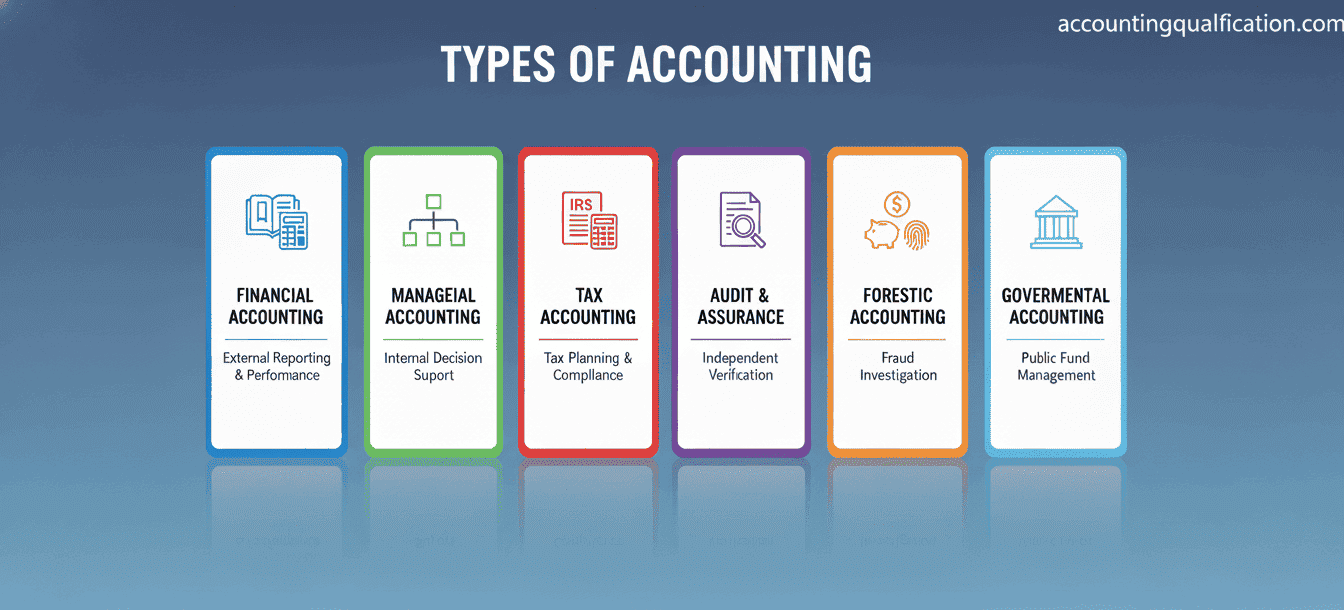
Learn all major different types of accounting with clear definitions, practical examples, and the best career paths for accounting professionals and students.
Choose a Accounting Type You Want to Learn
Accounting is the language of business. It helps organisations record, measure and communicate financial information that supports better decisions and ensures compliance.
There are many different types of accounting, each designed to meet specific needs. From financial and managerial accounting to forensic, digital and international accounting, every type plays an important role in business and finance. This page gives you a clear overview of the main accounting types so you can understand their purpose and where they are applied.
1. Financial Accounting
Financial accounting prepares clear and accurate financial statements for external stakeholders. It ensures transparency, comparability, and confidence in reporting. This discipline helps organisations present their financial truth with integrity. It brings clarity and trust to every decision.
Useful Points:
- Essential for statutory reporting and audits.
- Related qualifications: ACCA, ACA, CPA.
- Discover more in our guide to Financial Accounting.
2. Management Accounting
Management accounting provides internal insights for planning, budgeting, and strategic decision-making. It blends financial data with business operations to guide future performance. This discipline helps leaders respond with foresight and confidence. It empowers organisations to shape their future with purpose.
Useful Points:
- Supports forecasting, performance analysis, and planning.
- Common qualifications: CIMA, CMA.
- Explore our full article on Management Accounting.
3. Cost Accounting
Cost accounting evaluates the costs of products, services, and operations to improve efficiency and pricing. It provides detailed insight into cost behaviour and financial performance. This discipline strengthens operational strategy with precision. It gives businesses the clarity to grow intelligently.
Useful Points:
- Vital for production, manufacturing, and service organisations.
- Linked to CIMA and CMA.
- Read our comprehensive guide on Cost Accounting.
4. Tax Accounting
Tax accounting ensures compliance with tax laws while helping organisations ethically manage and optimise their tax obligations. It involves planning, reporting, and monitoring regulatory changes. This discipline reduces risk and protects financial health. It brings peace of mind through accuracy and care.
Useful Points:
- Key for compliance and tax efficiency.
- Qualifications: CTA, ATT, CPA.
- Learn more in our detailed guide to Tax Accounting.
5. Auditing
Auditing examines financial statements and internal controls to ensure accuracy, fairness, and reliability. It strengthens accountability, reduces risk, and builds confidence in organisational systems. This discipline enhances transparency where it matters most. It restores trust with every review.
Useful Points:
- Essential for organisations undergoing statutory audits.
- Linked with ACCA, ACA, CPA.
- Discover deeper insights in our guide to Auditing.
6. Corporate Accounting
Corporate accounting manages financial activities within large organisations, including reporting, budgeting, compliance, and capital management. It provides insights that support corporate financial strategy and long-term planning. This discipline ensures stability across complex structures. It brings order and confidence to corporate finance.
Useful Points:
- Relevant in multinational and large-scale environments.
- Supported by ACCA, CPA, MBA finance.
- Explore our full breakdown of Corporate Accounting.
7. Business Accounting
Business accounting covers day-to-day financial operations such as bookkeeping, cash management, and basic reporting. It builds the foundation for sound financial decision-making in any organisation. This discipline keeps businesses organised, compliant, and financially steady. It provides the stability every business deserves.
Useful Points:
- Suitable for SMEs and entrepreneurs.
- Linked with AAT and foundational accounting qualifications.
- Learn more in our dedicated guide to Business Accounting.
8. Consolidation Accounting
Consolidation accounting combines the financial statements of subsidiaries into a single unified report for a parent company. It ensures accuracy, consistency, and compliance across group entities. This discipline requires strong technical knowledge and precision. It unifies complex structures with clarity and purpose.
Useful Points:
- Essential for multinational groups and holding structures.
- Requires strong IFRS or GAAP understanding.
- Explore our detailed guide on Consolidation Accounting.
9. Holding Company Accounting
Holding company accounting focuses on managing financial relationships between parent companies and their subsidiaries. It includes investment tracking, dividend management, and intercompany transactions. This discipline supports transparent group-level reporting. It keeps multi-entity structures running smoothly and confidently.
Useful Points:
- Important for investment groups and corporate structures.
- Requires knowledge of consolidation and equity methods.
- Learn more in our guide to Holding Company Accounting.
10. Mergers and Acquisitions Accounting
M&A accounting handles valuation, due diligence, purchase price allocation, and post-acquisition adjustments. It ensures financial accuracy throughout major business transitions. This discipline demands technical skill and strategic insight. It supports companies through their most transformative moments.
Useful Points:
- Valuable in corporate finance and investment banking.
- Linked with CFA, ACCA, and advanced finance modules.
- Read our complete explanation of Mergers and Acquisitions Accounting.
11. Treasury Accounting
Treasury accounting manages cash flow, liquidity, investments, and financial risk. It supports organisational stability by ensuring funds are available when needed. This discipline protects financial strength and long-term sustainability. It builds confidence in every financial movement.
Useful Points:
- Essential for large organisations with active cash management.
- Linked with ACT qualifications.
- Explore more in our guide on Treasury Accounting.
12. Investment Accounting
Investment accounting tracks and values investment portfolios, including shares, bonds, and financial instruments. It ensures accurate reporting for investment performance and regulatory compliance. This discipline is crucial for asset managers and financial institutions. It brings clarity to wealth and long-term growth.
Useful Points:
- Used in investment firms, funds, and banks.
- Linked with CFA and investment-focused roles.
- Discover more in our full guide to Investment Accounting.
13. Equity Accounting
Equity accounting records investments where significant influence exists, typically in associates or joint ventures. It reflects the investor’s share of profits, losses, and net asset changes. This discipline creates a fair representation of shared ownership. It strengthens transparency in collaborative ventures.
Useful Points:
- Essential for group reporting and corporate structures.
- Requires strong knowledge of IFRS standards.
- Learn more through our guide to Equity Accounting.
14. Public Sector Accounting
Public sector accounting manages financial reporting for government bodies and public institutions. It focuses on accountability, budget control, and responsible use of public funds. This discipline ensures transparency in how public money is spent. It builds trust within communities and society.
Useful Points:
- Relevant for government entities and NGOs.
- Linked with CIPFA and public sector standards.
- Explore our full guide on Public Sector Accounting.
15. Fund Accounting
Fund accounting tracks financial resources that are allocated for specific purposes, often in non-profits, charities, and foundations. It prioritises accountability over profitability. This discipline ensures funds are used exactly as intended. It protects missions with care and integrity.
Useful Points:
- Ideal for charities, NGOs, and grant-funded bodies.
- Supports donor transparency and reporting.
- Learn more from our guide to Fund Accounting.
16. Judicial Accounting
Judicial accounting provides financial expertise in legal disputes, valuations, and court investigations. It bridges law and accounting to uncover truth in complex cases. This discipline requires accuracy, analysis, and objectivity. It brings clarity to situations where details truly matter.
Useful Points:
- Used in litigation, dispute resolution, and legal support.
- Closely related to forensic accounting.
- Explore deeper through our article on Judicial Accounting.
17. Regulatory Accounting
Regulatory accounting ensures compliance with industry-specific financial rules and reporting requirements. It is particularly important in sectors such as utilities, banking, and insurance. This discipline supports stability in heavily regulated environments. It brings order and reassurance to complex industries.
Useful Points:
- Essential for compliance-heavy organisations.
- Requires strong understanding of regulatory frameworks.
- Read more in our full guide to Regulatory Accounting.
18. Forensic Accounting
Forensic accounting investigates fraud, misconduct, and financial irregularities. It uses analytical techniques to uncover hidden patterns and support legal actions. This discipline strengthens organisational defences and exposes the truth. It delivers justice through numbers and detail.
Useful Points:
- Common in fraud detection and corporate investigations.
- Linked with CFE certification.
- Explore the field more in our guide to Forensic Accounting.
19. Investigative Accounting
Investigative accounting examines suspicious transactions and anomalies to identify errors, misstatements, or potential fraud. It involves deep analysis and critical thinking to uncover underlying issues. This discipline protects the organisation from financial risks. It brings clarity when uncertainty arises.
Useful Points:
- Used in internal audits and risk reviews.
- Supports fraud prevention programs.
- Learn more through our detailed guide on Investigative Accounting.
20. Compliance Accounting
Compliance accounting ensures adherence to internal policies, laws, and regulatory requirements. It helps organisations avoid penalties and maintain strong governance. This discipline strengthens internal systems and reduces risk exposure. It brings peace of mind through disciplined control.
Useful Points:
- Important for financial institutions and regulated industries.
- Works closely with compliance and legal teams.
- Explore our full insight into Compliance Accounting.
21. Risk-Based Accounting
Risk-based accounting aligns financial processes with potential risks, helping organisations prioritise areas needing attention. It strengthens control systems and supports proactive risk management. This approach safeguards organisations against future threats. It empowers teams to move with confidence and resilience.
Useful Points:
- Widely used in internal audit and risk management teams.
- Helps improve organisational governance.
- Learn more from our complete guide to Risk-Based Accounting.
22. Internal Control Accounting
Internal control accounting designs and evaluates systems that protect assets, reduce errors, and ensure reliable reporting. It aims to strengthen processes and keep organisations secure. This discipline enhances trust throughout the entire business. It creates a foundation of reliability and confidence.
Useful Points:
- Important for governance, fraud prevention, and compliance.
- Linked with internal audit and risk qualifications.
- Explore further in our guide to Internal Control Accounting.
Which Type of Accounting is Right for You?
Choosing the right accounting path can feel overwhelming with so many specialisations available. Whether you’re starting fresh or pivoting your career, understanding which type aligns with your goals, interests, and circumstances is crucial for long-term success.
For Students and Career Changers (Decision Tips)
Assess Your Natural Strengths and Interests
If you enjoy problem-solving and detective work, forensic accounting or auditing might suit you. These fields require analytical thinking and attention to detail when investigating discrepancies or ensuring compliance.
If you prefer working with people and business strategy, management accounting offers more client interaction and strategic input. You’ll work closely with managers to interpret financial data and guide business decisions.
If you thrive on precision and regulatory knowledge, tax accounting or financial accounting could be ideal. These areas demand accuracy and staying current with changing regulations.
Consider Your Learning Style and Patience Level
Some accounting types require extensive ongoing education. Tax accounting, for instance, means constantly updating your knowledge as legislation changes. Public sector accounting involves mastering complex regulations and standards.
Others, like basic bookkeeping or cost accounting, have more stable foundational principles that don’t shift as frequently.
Evaluate Your Career Timeline
Quick entry options: Bookkeeping, accounts payable/receivable, and basic financial accounting roles often require shorter training periods and offer faster employment opportunities.
Long-term investment paths: Becoming a chartered accountant, forensic specialist, or audit partner requires years of study and experience but offers higher earning potential and career prestige.
Decision Checklist for Students and Career Changers:
✅ What’s your risk tolerance? (High-stakes auditing vs. steady bookkeeping)
✅ Do you prefer variety or routine? (Forensic accounting vs. payroll processing)
✅ How much client interaction do you want? (Public practice vs. internal roles)
✅ What’s your study capacity? (Evening courses vs. full-time professional qualifications)
✅ Are you willing to relocate? (Some specialisations have geographic concentrations)
Best Accounting Type fo For SMEs and Startups
Essential Accounting Functions First
Start with financial accounting basics. Every business needs accurate bookkeeping, profit and loss tracking, and balance sheet preparation. This foundation supports everything else.
Implement management accounting early. Even small businesses benefit from budgeting, cash flow forecasting, and basic performance metrics. Don’t wait until you’re larger to start tracking key performance indicators.
Cost-Effective Approaches for Growing Businesses
Outsource complex specialisations initially. Tax planning, audit preparation, and forensic investigations are typically needed less frequently and can be handled by external specialists until you reach sufficient scale.
Invest in systems over people initially. Modern accounting software can handle many routine tasks, allowing you to focus human resources on analysis and strategic planning rather than data entry.
Growth-Stage Considerations
Manufacturing businesses should prioritise cost accounting systems early to understand product profitability and identify inefficiencies.
Service-based companies might focus more on project accounting and time tracking to ensure profitable client relationships.
Regulated industries need to establish compliance-focused accounting practices from the beginning, as retrofitting proper controls is more expensive than building them correctly initially.
SME Priority Checklist:
- ✅ Basic bookkeeping and financial statements (Month 1)
- ✅ Cash flow management and budgeting (Month 3)
- ✅ Tax compliance systems (Before first filing deadline)
- ✅ Management reporting and KPIs (Month 6)
- ✅ Internal controls and audit trail (Year 1)
- ✅ Specialised accounting (as needed for growth)
Types of Accounting – FAQS
1. What are the main types of accounting?
The main types of accounting include Financial Accounting, Management Accounting, Cost Accounting, Tax Accounting, and Auditing. These form the core foundation for all other specialised accounting fields.
2. What is the difference between financial accounting and management accounting?
Financial accounting focuses on preparing financial statements for external users like investors and regulators, whilst management accounting is used internally for planning, decision-making, and performance evaluation.
3. Why is cost accounting important for businesses?
Cost accounting helps businesses track production costs, control expenses, improve profitability, and make informed pricing decisions.
4. What does a tax accountant do?
A tax accountant handles tax planning, tax return preparation, compliance with tax laws, and helps individuals and businesses legally minimise tax liabilities.
5. What is the role of auditing in accounting?
Auditing involves examining financial records to ensure accuracy, transparency, and compliance with laws and accounting standards. It builds trust amongst investors and stakeholders.
6. What is corporate accounting used for?
Corporate accounting manages a company’s financial structure, including budgeting, financial reporting, compliance, and strategic financial planning for corporations.
7. How is business accounting different from corporate accounting?
Business accounting focuses on day-to-day financial transactions of small and medium businesses, whilst corporate accounting deals with large organisations and complex financial operations.
8. What is consolidation accounting?
Consolidation accounting combines the financial statements of a parent company and its subsidiaries into a single group report for accurate financial representation.
9. What is mergers and acquisitions (M&A) accounting?
M&A accounting manages the financial processes involved in business mergers, acquisitions, valuations, due diligence, and post-merger integration.
10. What is public sector accounting?
Public sector accounting is used by government organisations to manage public funds, ensure accountability, and comply with government financial regulations.
11. What is fund accounting and where is it used?
Fund accounting is mainly used by nonprofits, schools, hospitals, and government entities to track restricted funds separately instead of focusing on profit.
12. How do I choose the right type of accounting for my career?
Choose based on your career goals, interests, and skills.
If you enjoy analysis → Management or Cost Accounting
If you prefer compliance → Tax or Auditing
If you like investments → Investment or Equity Accounting
If you prefer government work → Public Sector or Fund Accounting