

Introduction to Management Accounting
Imagine trying to run a business without knowing which products make money, which departments overspend, or where your future risks lie. That’s where management accounting comes in.
Unlike financial accounting—which looks outward to investors and regulators—management accounting looks inward. It’s about giving managers the tools, numbers, and insights they need to steer the business in the right direction.
In many ways, management accounting is less about rules and more about decision-making. It answers questions like:
- Should we launch this new product?
- How much should we budget for marketing next year?
- Is this department working efficiently?
👉 According to a CIMA survey, over 80% of executives say management accounting plays a “critical role” in strategic decision-making.
What is Management Accounting?
Management accounting (sometimes called managerial accounting) is the practice of analysing financial and non-financial data to help managers make informed decisions.
Key features include:
- Internal focus – Reports are prepared for managers, not the public.
- Forward-looking – Emphasis on forecasts, budgets, and planning.
- Flexible format – Reports can be tailored to specific needs (not restricted to GAAP or IFRS).
- Decision-oriented – Provides insights to improve efficiency, profitability, and growth.
Key Benefits of Effective Management Accounting
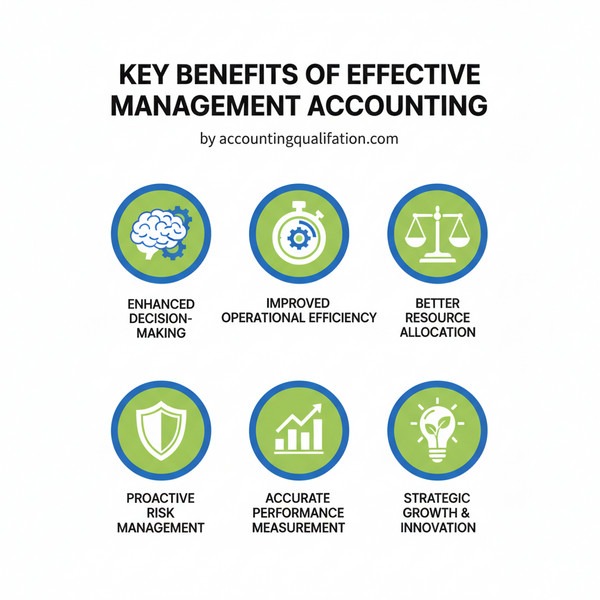
Implementing robust management accounting practices unlocks significant advantages for any organization. It transforms raw financial data into actionable intelligence, empowering leaders to make decisions that drive sustainable growth and profitability. Here are the core benefits:
Enhanced Decision-Making
Provides managers with timely, relevant data and insights for strategic choices on pricing, product lines, investments, and market entry.
Improved Operational Efficiency
Identifies bottlenecks, waste, and inefficiencies in processes, leading to cost reductions and streamlined operations.
Better Resource Allocation
Ensures capital, human resources, and materials are distributed optimally to maximize returns and achieve organizational goals.
Proactive Risk Management
Forecasting and variance analysis help in anticipating financial risks and market changes, allowing for timely mitigating actions.
Accurate Performance Measurement
Establishes clear KPIs and benchmarks, enabling precise monitoring of departmental and organizational performance against targets.
Strategic Growth and Innovation
Supports the evaluation of new opportunities and innovation initiatives by providing clear financial projections and impact assessments.
Challenges and Solutions in Management Accounting
While indispensable, management accounting is not without its hurdles. Organizations often face specific challenges that can hinder its effectiveness. Recognizing and addressing these issues is crucial for maximizing the value of internal financial insights.
1. Data Accuracy and Timeliness
Challenge: Relying on inaccurate, incomplete, or outdated data can lead to flawed analyses and poor decision-making. Data silos and manual input errors are common culprits.
Solution: Implement robust data governance frameworks, automate data collection processes where possible, and integrate disparate systems (e.g., ERP, CRM) to ensure a single source of truth and real-time data accessibility.
2. Technology Adoption and Integration
Challenge: Many businesses struggle to fully leverage modern accounting software, BI tools, and forecasting models. Legacy systems or a lack of integration can create inefficiencies.
Solution: Invest in scalable technology solutions that integrate seamlessly. Provide comprehensive training to accounting teams and other stakeholders to ensure effective utilization of new tools.
3. Skill Gap in Analytics and Business Acumen
Challenge: Management accountants need more than traditional bookkeeping skills; they require strong analytical capabilities, data visualization expertise, and a deep understanding of business operations.
Solution: Foster continuous professional development, encourage cross-functional training, and recruit talent with a blend of financial expertise and data science or business analytics skills. Programs like CIMA can help bridge this gap.
4. Resistance to Change and Communication Barriers
Challenge: New processes or reporting formats can be met with resistance from various departments. Effective communication of insights can also be difficult if financial jargon isn’t translated into actionable business language.
Solution: Champion a culture of data-driven decision-making from the top down. Emphasize collaboration, provide clear explanations of new initiatives, and train management accountants to communicate complex financial information in a concise, business-focused manner to non-financial managers.
The Future Landscape of Management Accounting
The field of management accounting is undergoing a significant transformation, driven by technological advancements and evolving business demands. Future-focused management accountants will be strategic partners, leveraging cutting-edge tools to provide even deeper insights.
1. Rise of AI and Machine Learning
Artificial intelligence and machine learning are automating routine tasks like data entry, reconciliation, and basic reporting. This frees management accountants to focus on higher-value activities such as predictive analytics, scenario planning, and strategic advisory roles. AI algorithms can identify patterns and anomalies much faster than human analysis, enhancing forecasting accuracy and fraud detection.
2. Predictive and Prescriptive Analytics
Moving beyond descriptive (what happened) and diagnostic (why it happened) analytics, the future emphasizes predictive (what will happen) and prescriptive (what should we do) capabilities. Management accountants will increasingly use advanced models to forecast market trends, customer behavior, and operational outcomes, providing proactive recommendations to guide business strategy.
3. Enhanced Role in ESG Reporting
Environmental, Social, and Governance (ESG) factors are becoming critical for investor relations and corporate reputation. Management accountants will play a vital role in measuring, analyzing, and reporting non-financial data related to sustainability, ethical practices, and social impact, integrating these metrics into overall business performance evaluation.
4. Real-time Data and Integrated Systems
The demand for real-time insights is growing. Future management accounting will heavily rely on fully integrated ERP systems, cloud-based platforms, and IoT (Internet of Things) devices to provide continuous streams of data. This allows for immediate performance monitoring and rapid adjustments to business plans.
5. Focus on Data Storytelling and Strategic Business Partnering
As data becomes more abundant, the ability to translate complex analytics into compelling narratives and actionable insights will be paramount. Management accountants will evolve into crucial strategic business partners, advising C-suite executives on growth opportunities, risk mitigation, and operational excellence, requiring strong communication and influencing skills.
Objectives of Management Accounting
The main goals of management accounting can be summed up in three words: plan, control, decide.
- Planning – Setting budgets, forecasting sales, and allocating resources.
- Controlling – Monitoring performance against targets and identifying variances.
- Decision-making – Supporting strategic choices with data-driven analysis.
👉 Example: A retail chain might use management accounting to decide whether to close underperforming stores or expand into new regions.
Key Techniques of Management Accounting
Management accounting uses a variety of techniques to transform raw numbers into insights. Some of the most widely used include:
1. Budgeting
Budgets are financial roadmaps. They set spending limits, allocate resources, and provide benchmarks for performance.
👉 Example: A marketing team may get a £100,000 annual budget. If they overspend by £20,000, management accounting highlights the variance, prompting managers to act.
2. Standard Costing and Variance Analysis
Companies set “standard” costs for producing goods or services. Management accountants then compare actual costs to these standards.
👉 Example: If producing one unit of a product should cost £10 but actually costs £12, the £2 variance signals inefficiency.
3. Break-Even Analysis
This technique identifies the sales volume needed to cover costs, beyond which profit begins.
👉 Example: A bakery calculates it must sell 2,000 loaves a month to break even. Selling more brings profit; selling less brings loss.
4. Cost-Volume-Profit (CVP) Analysis
Looks at how changes in costs and sales volume affect profit. It’s particularly useful for pricing decisions and new product launches.
5. Performance Metrics (KPIs)
Management accountants track Key Performance Indicators such as gross margin, return on investment (ROI), or employee productivity.
Tools of Management Accounting
Modern management accountants rely on both traditional methods and cutting-edge technology.
- Spreadsheets (Excel/Google Sheets) – Still the backbone for many small and medium businesses.
- Enterprise Resource Planning (ERP) Systems – Integrated systems like SAP, Oracle, or NetSuite provide real-time data.
- Business Intelligence (BI) Tools – Platforms such as Power BI or Tableau help visualise trends and performance.
- Forecasting Models – Statistical tools and AI models predict sales, costs, and market changes.
👉 A Deloitte report found that 67% of CFOs now use data analytics tools as part of management accounting for better decision-making.
Examples of Management Accounting in Action
Manufacturing Company
A car manufacturer uses management accounting to analyse production costs. By identifying waste in materials and labour, they reduce costs per vehicle and boost profit margins.
Service Industry
A hotel chain uses forecasting to predict seasonal demand. This helps allocate staff and resources efficiently, ensuring profitability during peak and off-peak seasons.
Start-Ups
A tech start-up uses management accounting to monitor cash flow burn rate, helping founders decide whether to seek new funding or slow expansion.
Careers in Management Accounting
Management accounting offers a dynamic career path that blends finance, strategy, and leadership.
Common Roles
- Management Accountant – Prepares budgets, reports, and performance analyses.
- Business Analyst – Uses data to identify trends and improve efficiency.
- Financial Planning & Analysis (FP&A) Specialist – Forecasts performance and supports strategic decisions.
- Finance Business Partner – Works closely with other departments, advising managers on financial implications.
- Chief Financial Officer (CFO) – Senior executive responsible for overall financial strategy.
Skills Needed
- Analytical mindset
- Strong business understanding
- Communication and presentation skills
- Ability to work with technology and data
- Ethical decision-making
👉 The Chartered Institute of Management Accountants (CIMA) reports that qualified management accountants are in demand worldwide, with opportunities to work across industries and even move into senior executive roles.
Why Management Accounting Matters
Management accounting is more than just crunching numbers—it’s about turning information into action.
- Better Planning: Managers can set realistic goals and allocate resources effectively.
- Performance Control: Variance analysis helps spot inefficiencies and correct them quickly.
- Strategic Decisions: Data-driven insights support decisions on pricing, product launches, and market expansion.
- Risk Management: Forecasting tools highlight potential challenges before they become major problems.
👉 Fact: According to a PwC CFO Pulse Survey, 77% of business leaders say financial planning and analysis (a key part of management accounting) is now central to strategy, not just support.
What is management accounting in simple terms?
It’s the process of analysing financial and non-financial data to help managers plan, control, and make better decisions.
How is management accounting different from financial accounting?
Financial accounting is for external reporting (investors, regulators), while management accounting is for internal use by managers.
What are the main techniques of management accounting?
Common techniques include budgeting, variance analysis, break-even analysis, cost-volume-profit analysis, and performance measurement.