

choosing between ACA vs ACCA, salary potential often becomes the deciding factor for many aspiring accountants. These prestigious qualifications represent two distinct paths in the accounting profession, each offering unique career trajectories and earning potential.
While both certifications are highly regarded in the financial sector, their salary structures can vary significantly based on factors like industry, location, and experience level. The choice between these qualifications can substantially impact your earning potential throughout your career journey.
This comprehensive guide examines the salary differences between ACA and ACCA qualified professionals across various career stages, from entry-level positions to senior roles. Whether you’re starting your accounting career or planning your next professional move, understanding these salary distinctions will help you make an informed decision about your future.
Understanding ACA and ACCA Basics
The ACA and ACCA qualifications stand as cornerstones in the accounting profession, each offering distinct pathways to professional success. Both qualifications demand rigorous study and practical experience, albeit with notable differences in their structure and focus.
Key Features of ACA Qualification
The Institute of Chartered Accountants in England and Wales (ICAEW) oversees the ACA qualification, which follows a structured approach across three levels. The programme consists of 15 examinations divided into certificate, professional, and advanced stages [1].
The qualification maintains high entry standards, typically requiring a bachelor’s degree or equivalent education. Nevertheless, alternative pathways exist for candidates with A-levels or relevant work experience [1].
A distinguishing aspect of the ACA qualification lies in its practical training requirements. Students must complete a minimum of 450 days of relevant work experience, generally spanning 3 to 5 years [1]. This hands-on training takes place through ICAEW-authorised employers, ensuring consistent quality standards across the profession.
The ACA programme particularly excels in developing technical accounting and auditing expertise. Furthermore, students must demonstrate proficiency in seven areas of professional skills and maintain strict adherence to the ICAEW Code of Ethics [2].
Core Elements of ACCA Certification
The ACCA qualification, administered by the Association of Chartered Certified Accountants, presents a more flexible pathway into the accounting profession. The certification process encompasses 13 examinations across three distinct levels [1].
The examination structure includes:
- Three Applied Knowledge exams covering fundamental accounting techniques
- Six Applied Skills exams focusing on advanced technical skills
- Four Strategic Professional exams, with students selecting two from available options [1]
Additionally, ACCA candidates must complete an Ethics and Professional Skills module, emphasising the importance of ethical decision-making in professional practise [2]. The qualification requires three years of practical experience, offering greater flexibility in training arrangements compared to the ACA programme [1].
One notable advantage of the ACCA qualification lies in its international recognition. ACCA-qualified practitioners can work as accountants in 170 countries, including major financial centres such as the UK, USA, Canada, and Singapore [1].
Both qualifications mandate ongoing professional development, with practitioners required to complete 40 CPD hours annually and maintain adherence to professional ethics standards [1]. Moreover, both paths necessitate student membership with their respective institutes – ICAEW for ACA and ACCA for their qualification [1].
The ACCA programme particularly suits those seeking broader business and financial management skills. The curriculum encompasses various subjects, including strategy, reporting, auditing, taxation, and management, preparing professionals for diverse roles across the financial sector [1].
For maintaining professional standing, both qualifications require adherence to the Code of Ethics for Professional Accountants and regular payment of annual membership fees [1]. This commitment ensures practitioners remain current with industry standards and maintain their professional competency throughout their careers.
Entry-Level Salary Comparison
Entry-level salaries for accounting professionals showcase distinct variations based on qualifications and geographic locations. A thorough analysis of starting compensation reveals notable differences between ACA and ACCA pathways.
Starting Salaries for ACA Graduates
ACA trainees begin their careers with competitive compensation packages. The average starting salary for ACA Graduate Trainees ranges from £24,991 to £36,506 per year [3]. Based on experience and career progression, the total pay can reach up to £43,288 [3].
Graduate-level positions at the Big 4 firms offer varying compensation depending on specialisation:
- Audit and assurance: £20,000–£22,000
- Tax: £20,000–£26,000
- Advisory: £22,000–£24,000
- Corporate finance: £24,000–£26,000 [4]
First-Year ACCA Salaries
ACCA qualified professionals typically start with lower initial salaries in comparison to their ACA counterparts. Entry-level ACCA positions offer salaries ranging from £25,000 to £30,000 annually [2]. However, trainee ACCA accountants might see variations in their starting packages, with salaries spanning from £19,000 to £25,000 [4].
The corporate sector often presents higher starting salaries for ACCA graduates. Specific roles command different compensation levels:
- Banking: £25,000-£30,000
- Auditing: £23,000-£35,000
- Taxation: £25,000-£40,000 [2]
Regional Salary Variations
Salary differences across regions remain substantial for both qualifications. London consistently offers the highest compensation packages, followed by other major metropolitan areas.
For ACA professionals:
- City of London: £62,492 (range: £52,500-£72,500)
- Central London: £57,500 (range: £47,500-£67,500)
- Reading: £57,500 (range: £47,500-£57,500)
- Brighton: £57,500 (range: £43,750-£72,500) [3]
Regional variations for ACCA qualified accountants show similar patterns. In Wales, entry-level positions start from £14,000, whereas London-based roles command up to £24,000 [5]. Part-qualified accountants in London can earn up to £34,000, surpassing the national average of £33,000 [5].
Certain regions offer unique advantages. East Anglia has witnessed notable growth, with graduate salaries increasing by 4.9% from 2022 [6]. Cambridgeshire leads the region with graduate salaries reaching £25,000 [6].
The public sector presents distinct salary structures. The National Audit Office offers over £25,000 in Newcastle and exceeds £30,000 in London [4]. Similarly, the Civil Service Fast Stream (finance) provides £28,000, whilst the NHS Graduate Management Training Scheme pays £26,382 [4].
Long-Term Career & Senior-Level Salary Prospects
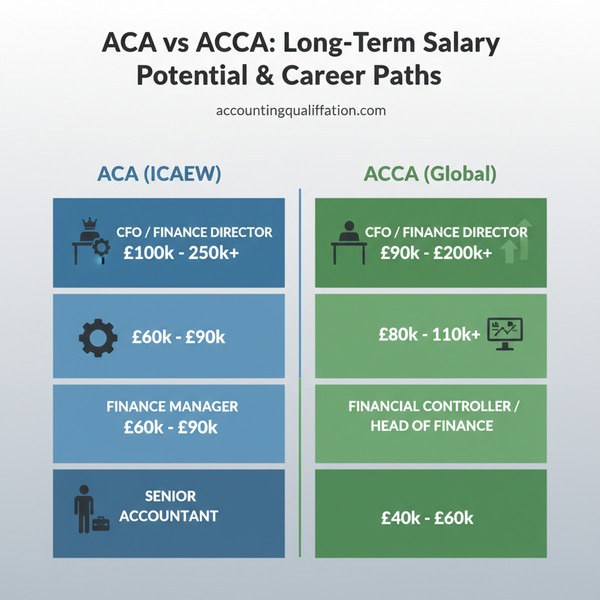
As accounting professionals climb the corporate ladder, the earning potential for both ACA and ACCA qualified individuals sees substantial growth. While both paths can lead to senior leadership roles, the trajectory and typical salary ranges diverge at the highest echelons, often reflecting their foundational specialisations and industry recognition.
Senior Accountant & Finance Manager: With 5-10 years of experience, both qualifications position professionals for senior accounting and finance manager roles. ACA holders, particularly those with Big Four backgrounds, often transition into demanding corporate finance or financial controller positions, commanding salaries ranging from £70,000 to £100,000+. ACCA professionals, leveraging their broader business acumen, excel in diverse industry sectors, with salaries typically falling within £60,000 to £95,000 for similar roles.
Financial Controller & Head of Finance: At this level, strategic oversight and leadership become paramount. ACA-qualified Financial Controllers in large corporations or complex group structures can earn upwards of £90,000 to £150,000. ACCA professionals in Head of Finance or Controller positions, especially within SMEs or international organisations, often see salaries in the £80,000 to £130,000 bracket, showcasing strong leadership and operational expertise.
CFO & Finance Director: Reaching the pinnacle of finance leadership as a Chief Financial Officer (CFO) or Finance Director demonstrates exceptional strategic influence. ACA qualifications are historically strong for these roles, particularly in FTSE 100 companies or large listed entities, with salaries starting from £150,000 and potentially exceeding £500,000, including bonuses and equity. ACCA-qualified CFOs are increasingly prevalent, especially in growth companies, international markets, and specific industries, with compensation ranging from £120,000 to £300,000+, highlighting their comprehensive business understanding.
Understanding these long-term prospects is vital for aspiring accountants to align their qualification choice with their ultimate career ambitions.
Key Factors Influencing ACA & ACCA Salaries
Beyond the inherent prestige of either qualification, several critical factors significantly influence the salary potential for both ACA and ACCA professionals. Understanding these elements can help individuals strategically plan their career trajectory and maximise their earning power.
Location: Geographic location is paramount. London consistently offers the highest salaries for both ACA and ACCA roles due to its status as a global financial hub. Major cities like Manchester, Birmingham, and Edinburgh also command competitive remuneration, albeit generally lower than the capital. Rural areas or smaller towns typically present more modest salary packages.
Industry Sector: The sector in which an accountant operates plays a crucial role. For ACA, the Big Four accounting firms (Deloitte, PwC, EY, KPMG) often provide higher starting salaries and rapid progression, especially in audit and advisory. Subsequently, moving into corporate finance, private equity, or investment banking can lead to substantial remuneration. For ACCA, opportunities are vast across commercial industry, public sector, and not-for-profit organisations, with high earning potential in multinational corporations, tech, and banking sectors.
Firm Size and Type: Working for a large, international organisation or a prestigious firm generally translates to higher salaries and more comprehensive benefits compared to smaller local practices or SMEs. However, smaller firms can offer broader exposure to different aspects of accounting, potentially accelerating skill development.
Specialisation: Niche expertise can significantly boost earning potential. Specialists in areas like international tax, forensic accounting, cybersecurity auditing, or M&A advisory often command premium salaries due to their in-demand skills. Both ACA and ACCA professionals can specialise, but the nature of specialisation might align differently with their core training.
Experience & Post-Qualification Experience (PQE): This is perhaps the most obvious factor. As professionals gain more years of experience, particularly post-qualification, their value to employers increases, directly correlating with higher salaries. Rapid progression and taking on more responsibility also accelerate salary growth.
Soft Skills & Leadership Abilities: Beyond technical prowess, strong communication, leadership, problem-solving, and strategic thinking skills are increasingly valued. Accountants who can effectively manage teams, influence decisions, and contribute to strategic growth are indispensable, leading to higher compensation, especially in senior management roles.
Making Your Choice: ACA vs. ACCA for Your Career Goals
Deciding between the ACA and ACCA qualifications is a pivotal career choice that should align with your long-term professional aspirations. While both lead to successful accounting careers, their unique strengths cater to different pathways.
Consider Your Career Path:
- If Your Goal is Big Four and Corporate Finance: The ACA qualification is often perceived as the preferred route for a career within the Big Four firms in the UK, offering structured training and a strong foundation for moving into corporate finance, investment banking, or high-level finance roles within large listed companies. Its focus on audit and technical accounting is highly regarded in these sectors.
- If You Seek Global Flexibility and Diverse Industries: The ACCA qualification boasts broader international recognition, making it an excellent choice for those aspiring to work globally or across a wide array of industries. Its curriculum covers a more extensive range of business and financial management topics, preparing professionals for varied roles in commercial, public, or non-profit sectors, both domestically and overseas.
Training and Study Style:
- Structured vs. Flexible: ACA typically involves a more structured training contract, often with an authorised training employer (ATE), usually a practice firm. ACCA offers greater flexibility in gaining practical experience and allows for part-time study alongside work, appealing to those who prefer a more adaptable learning journey or are already employed in finance roles.
- Depth vs. Breadth: ACA is renowned for its depth in audit and financial reporting, cultivating highly technical accountants. ACCA provides a broader understanding of business, strategy, and management accounting, equipping professionals with a wider skill set applicable across different business functions.
Long-Term Earning Potential: While our salary comparisons show slight variations at entry and mid-level, both qualifications lead to significant earning potential at senior levels. The key difference lies in the typical industries and types of firms where each qualification might traditionally command the highest salaries.
Ultimately, your choice should reflect your personal career ambitions, preferred study method, desired industry, and geographic flexibility. Researching specific job roles and speaking with professionals holding each qualification can provide invaluable insights to help you make an informed decision for your future in accounting.
Mid-Career Earnings Analysis
Professional accountants witness substantial salary growth during their mid-career phase, marking a period of increased earning potential. The compensation packages reflect expertise gained through practical experience and advanced qualifications.
3-5 Years Experience Salary Ranges
ACA and ACCA qualified professionals with 3-5 years of post-qualification experience command impressive salaries. ACA/ACCA qualified accountants with 3-5 years of experience earn between £65,000 and £75,000 annually [7]. Correspondingly, those with 1-3 years of post-qualification experience receive comparable compensation packages [7].
The salary progression remains steady across both qualifications. ACCA professionals at the middle level earn between £40,000 and £100,000 [8], whilst ACA holders with similar experience command salaries starting from £51,000 [9].
Recent market trends indicate a notable increase in compensation packages. Financial sector salaries have risen between 5% and 10% across various positions, with qualified and managerial roles experiencing an average increase of 10% [10].
Industry-Specific Pay Differences
Different sectors offer varying compensation structures for mid-career professionals. The banking sector presents lucrative opportunities, with ACCA-qualified professionals earning between £25,000 and £48,000, advancing to £48,000-£70,000 for senior positions [8].
The audit sector demonstrates strong earning potential:
- Entry to mid-level: £32,000-£38,000 plus study support and benefits
- Senior positions: £55,000-£75,000 annually [8]
Financial consulting roles offer substantial compensation packages. Mid-level consultants earn £25,000-£45,000 plus commission, with potential earnings reaching £100,000 for experienced professionals [8].
Taxation specialists see consistent growth in their earnings:
- Mid-level positions: £35,000-£55,000
- Senior roles: £80,000-£110,000 annually [8]
Business management positions present attractive compensation:
- Mid-level roles: £45,000-£52,000 plus benefits
- Senior positions: £90,000-£110,000 plus bonuses [8]
Location significantly influences salary levels. For instance, the City of London offers higher compensation packages, with average salaries ranging from £52,500 to £72,500 [11]. In contrast, regional variations show different patterns:
- Poole, Dorset: £47,500-£78,750
- Hatfield, Hertfordshire: £57,500-£72,500
- Uxbridge: £52,500-£91,182 [11]
Corporate sector positions typically offer higher compensation than public sector roles [8]. Banking and insurance companies present particularly attractive packages for chartered certified accountants [8]. Internal audit managers in large London-based companies can earn up to £102,900 [5], whilst group accountants receive between £60,600 and £97,400 [5].
The progression path remains clear, with experienced professionals commanding higher salaries as they take on increased responsibilities and handle complex projects [5]. Specialisation in specific areas, alongside gaining additional qualifications, contributes to enhanced earning potential [8].
Mid-career professionals benefit from comprehensive benefits packages alongside their base salaries. These often include performance-based bonuses, particularly prevalent in financial services and corporate sectors [2]. The combination of base salary and additional benefits creates attractive total compensation packages for qualified accountants in their mid-career phase.
Senior Level Income Potential
At the pinnacle of their careers, both ACA and ACCA qualified professionals command substantial compensation packages, reflecting their expertise and leadership roles. The salary structures at senior levels showcase notable distinctions between these qualifications.
Director-Level Compensation
Senior-level ACA professionals in director positions earn an average of £160,000 at large firms and £135,000 at SMEs in London [4]. Outside London, directors at large firms in regions like East Midlands, North East, and Yorkshire command approximately £70,000 annually [4].
ACCA qualified professionals in director-level positions can expect salaries exceeding £100,000 [2]. The financial services sector, specifically banking and insurance companies, offers higher compensation packages for ACCA directors [2].
Partnership Earnings
Partnership earnings present a distinct tier of income potential. According to recent data, ACA qualified professionals see the highest pay grade, earning £92,348 on average [12]. In comparison, ACCA partners receive £69,698 annually [12].
The partnership structure influences earnings through:
- Profit sharing ratios
- Capital contributions
- Individual performance metrics
- Client portfolio value
Additional Benefits Package Worth
Beyond base salaries, senior-level professionals receive comprehensive benefits packages. Standard benefits include:
- Personal accident insurance
- Life assurance
- Enhanced pension schemes with company contributions
- Interest-free season ticket loans [4]
The total compensation package often encompasses performance-related bonuses, especially prevalent in financial services and corporate sectors [2]. Senior positions at large firms offer flexible benefit options, allowing professionals to tailor their packages according to personal preferences.
Notably, 38% of ACCA qualified professionals advance to senior or director roles [12], underlining the strong career progression potential. The demand for skilled accountancy professionals continues rising, creating opportunities for enhanced compensation packages [13].
Location remains a crucial factor in determining senior-level earnings. London-based positions consistently offer higher compensation, although regional variations present attractive opportunities. For instance, senior roles in East Anglia have witnessed a 4.9% salary increase [4].
The current market dynamics favour experienced professionals, as companies struggle to retain top talent. This trend has led to enhanced remuneration packages, alongside additional perks and benefits [13]. Consequently, senior-level accountants should regularly benchmark their compensation against market rates to ensure fair remuneration for their expertise and responsibilities.
Factors Affecting Salary Growth
Several key determinants shape the salary trajectory of accounting professionals throughout their careers. Understanding these factors helps in making informed decisions about career paths and maximising earning potential.
Industry Choice Impact
The financial sector presents varying compensation structures across different industries. Finance and insurance sectors offer the highest salaries, with accountants earning between £63,532 and £95,299 annually [1]. The technology sector follows closely, providing annual compensation ranging from £67,503 to £103,240 [1].
Nonetheless, certain sectors offer lower compensation packages:
- Non-profit organisations: £39,708 to £55,591 annually [1]
- Government roles: £43,678 to £59,562 per year [1]
- Educational institutions: £47,649 to £63,532 annually [1]
The healthcare sector maintains competitive salaries, with accountants earning between £59,562 and £87,357 [1]. Indeed, industry accountants often receive different compensation packages compared to firm accountants [5].
Location Influence
Geographic location substantially affects salary levels for both ACA and ACCA professionals. Major financial hubs consistently offer higher compensation due to increased business activity and cost of living considerations [1].
The regional salary distribution shows distinct patterns:
- London and South East: Highest average salaries due to concentrated financial activity [14]
- North-South divide: Clear salary differentials between northern and southern regions [14]
- Scotland and Wales: CIMA qualifications command higher pay rates [14]
Salary variations extend beyond national borders. ACCA maintains strong international recognition across 180 countries, presenting opportunities for global career advancement [15]. Therefore, professionals considering relocation should evaluate both domestic and international opportunities [14].
Specialisation Benefits
Developing expertise in specific areas significantly enhances earning potential. The flexible structure of accounting qualifications enables specialisation in various fields, thereby increasing market value [3].
Key specialisation areas that command premium salaries include:
- Financial advisory services
- Forensic accounting
- Risk management
- Strategic planning
- Corporate finance [3]
Professional development through additional certifications also influences salary growth. Credentials such as International Financial Reporting Standards and Information System Auditor certifications enhance job prospects and initial compensation [3].
Continuous professional development remains crucial, as staying current with industry changes adds value to professional competency [3]. Furthermore, building strong professional networks and maintaining client relationships directly impacts earning potential [3].
The size and type of employer also affect compensation levels. Big 4 firms typically offer higher salaries than SMEs [5]. Likewise, skill sets, responsibilities, and sector-specific expertise carry more weight in determining salary levels than traditional factors like years of service [16].
Fast-expanding companies often provide better packages and employee remuneration [3]. Undoubtedly, performance history, decision-making abilities, and experience handling complex situations influence salary negotiations with new organisations [3].
Conclusion
Choosing between ACA and ACCA qualifications presents distinct career advantages and earning potential. While ACA professionals generally command higher starting salaries, particularly in Big 4 firms, ACCA qualified accountants benefit from greater international mobility and diverse career paths.
Salary data reveals significant earning potential for both qualifications. Entry-level ACA graduates earn between £24,991 and £36,506, whereas ACCA starts slightly lower at £25,000 to £30,000. Mid-career professionals with either qualification can expect substantial growth, reaching £65,000 to £75,000 with 3-5 years of experience. Senior roles, especially directorships and partnerships, offer the highest rewards, with ACA partners earning around £92,348 compared to ACCA partners at £69,698.
Location plays a crucial role in compensation, with London consistently offering premium salaries. Specialisation choices also significantly affect earning potential, particularly in financial advisory services, forensic accounting, and corporate finance. The financial services sector presents the most lucrative opportunities, though technology and healthcare industries maintain competitive compensation packages.
Both qualifications offer strong career prospects, though their paths differ slightly. ACA suits those targeting traditional accounting roles and partnership tracks, while ACCA provides flexibility across various business sectors and international markets. Success in either path depends largely on individual career goals, preferred work environment, and willingness to pursue additional specialisations.
FAQs
What is the main difference between ACA and ACCA qualifications?
ACA (offered by ICAEW) is often seen as audit-focused with a UK-centric emphasis, while ACCA has a more international scope and flexible routes.
Which qualification tends to lead to higher salaries – ACA or ACCA?
ACA-qualified accountants generally command slightly higher average salaries in the UK due to the qualification’s prestige and rigorous training.
Does ACA guarantee a better job than ACCA?
Not necessarily—both qualifications are highly respected. Career outcomes depend on experience, location, and industry sector.
Which is more flexible in terms of study options?
ACCA offers more flexibility with global exam centres, remote study options, and multiple entry points.
Is ACA better for careers in the Big Four firms?
Many Big Four firms in the UK prefer or require ACA, particularly for audit and assurance roles.
Can ACCA-qualified accountants become chartered?
ACCA members achieve chartered certified status and can practise internationally, although the ACA may be more recognised in specific UK markets.
How long does it take to complete each qualification?
Both take roughly 3–4 years, though ACA requires a formal training contract with an authorised employer.
Which qualification has more international mobility?
ACCA is generally more portable internationally, with widespread recognition in over 180 countries.