

Accounting is the backbone of any business, big or small. For those serious about pursuing a career in this field, the right qualification can make all the difference. Whether you’re aiming for the corporate world, public sector, or self-employment, understanding the top accounting qualifications available in the UK is crucial.
Overview of Key Accounting Qualifications
The UK offers a range of accounting qualifications tailored to diverse career goals. Let’s break down the most prominent ones and what they bring to the table.
AAT (Association of Accounting Technicians)

Photo by Mikhail Nilov
The AAT qualification is a great starting point for anyone stepping into accounting. It’s structured across three levels: Foundation, Advanced, and Professional. Each level builds on your knowledge and skills in bookkeeping, accounts preparation, and tax.
AAT is seen as your gateway into a professional career. It’s often chosen by those early in their journey or people looking to refine practical accounting skills. After completing AAT, many progress to advanced qualifications like ACCA or CIMA.
Careers with AAT: Accounts assistant, bookkeeper, audit trainee.
ACA (Association of Chartered Accountants)
The ACA qualification, offered by the ICAEW, is one of the most prestigious. It’s rigorous, often requiring trainees to work while studying. With 15 exam modules and practical work experience, the ACA combines theoretical expertise with real-world application.
What sets ACA apart is its focus on financial reporting. It’s perfect for those wanting to work in traditional accounting roles or within auditing.
Typical roles for ACA-qualified accountants: Auditor, tax consultant, CFO.
ACCA (Association of Chartered Certified Accountants)
If international recognition is a priority, the ACCA qualification might be your best bet. With a flexible syllabus that includes 13 exams, ACCA prepares candidates for a broad range of industries. It’s known for its emphasis on global finance and management.
ACCA graduates can work in almost any sector, from startups to multinational corporations. Its widespread acceptance makes it a popular choice for those wanting career mobility.
Industries ACCA caters to: Finance, banking, consulting, and more.
CIMA (Chartered Institute of Management Accountants)
The CIMA qualification specialises in management accounting. It’s geared towards those who want to develop business strategies and understand corporate finance on a deeper level. The course focuses on financial strategy, risk management, and decision-making.
With four levels to complete, CIMA places accountants at the heart of business operations. It’s ideal for those who want to influence major financial decisions in organisations.
Career options with CIMA: Management accountant, financial analyst, business strategist.
CIPFA (Chartered Institute of Public Finance and Accountancy)
When it comes to public sector accounting, CIPFA stands out. This unique qualification focuses on financial management in government, charities, and other public bodies.
CIPFA suits those passionate about making an impact in non-private sectors. It equips professionals to handle public finances responsibly in a world of regulations and transparency.
Roles CIPFA leads to: Public finance accountant, financial auditor in government departments.
Choosing the Right Qualification for Your Career Goals
There’s no one-size-fits-all when it comes to accounting qualifications. Choosing the right one depends on your aspirations, interests, and the career path you envision.
Assessing Your Career Aspirations
First, think about where you see yourself in the next five or ten years. Do you want to advise corporations on tax strategies? Or are you more interested in forecasting financial risks for global companies?
For instance:
- Dreaming of a traditional auditing role? ACA could be your fit.
- Want to focus on corporate strategy? Consider CIMA.
- Keen on international opportunities? ACCA opens doors worldwide.
Understanding Specialisations in Accounting
Accounting is a diverse field. Some qualifications gear you toward specific niches:
- Management Accounting: CIMA is your go-to.
- Public Sector: CIPFA focuses on roles in government and public finances.
Knowing these nuances ensures your qualification aligns with your interests.

Job Market Trends and Demands
Keeping an eye on job market trends can help guide your choice. Currently, professionals with CIMA and ACCA qualifications are in high demand due to the focus on strategic decision-making and financial planning. Meanwhile, ACA and CIPFA are sought after in sectors needing expertise in reporting and compliance.
Research industries you’re interested in and assess what qualifications are most frequently listed in job requirements.
Key Differences Between UK Accounting Qualifications
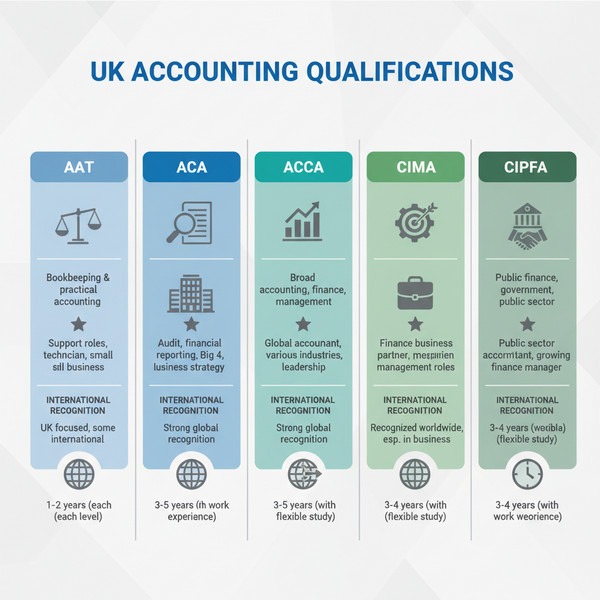
Key Differences Between UK Accounting Qualifications
Navigating the various accounting qualifications can be complex. While each path leads to a rewarding career, understanding their core differences is crucial for aligning with your personal and professional aspirations. This section simplifies the distinctions, helping you to make an informed choice.
We compare AAT, ACA, ACCA, CIMA, and CIPFA across critical aspects such as their primary focus, typical career progression, international recognition, and the average duration of study. This overview highlights which qualification might best suit your interests, whether you’re aiming for audit, management accounting, public finance, or a globally recognised general practice.
Entry Requirements and Study Pathways for UK Accounting Qualifications
Entry Requirements and Study Pathways for UK Accounting Qualifications
Embarking on an accounting career in the UK requires understanding the prerequisites and various study routes available for each qualification. This insight is essential for planning your educational journey effectively, whether you’re a school leaver, a graduate, or a professional seeking a career change.
For instance, AAT qualifications typically have no formal entry requirements, making them accessible to beginners. They can be studied flexibly through colleges, online providers, or apprenticeships. In contrast, ACA often requires a university degree, usually a 2:1 or higher, and necessitates a training contract with an authorised employer. Similarly, ACCA generally requires two A-Levels and three GCSEs (or equivalent), or a relevant degree for exemptions, offering extensive global study provider networks.
CIMA also welcomes candidates with varying academic backgrounds, from GCSEs to degrees, often providing exemptions. Their study is highly flexible, including self-study, online, and classroom options. CIPFA is tailored for the public sector, often requiring a degree or relevant professional experience, with study options including apprenticeships and distance learning. Exploring these pathways ensures you choose a qualification that aligns with your current academic standing and preferred learning style.
Beyond the Exams: Practical Experience and Continuous Professional Development (CPD)
Beyond the Exams: Practical Experience and Continuous Professional Development (CPD)
Achieving an accounting qualification is a significant milestone, but true mastery and career longevity extend beyond passing exams. Practical experience and an ongoing commitment to Continuous Professional Development (CPD) are fundamental pillars of a successful accounting career in the UK.
Most professional accounting bodies, including ICAEW (ACA), ACCA, and CIMA, mandate a period of relevant practical work experience, typically 36 months, as part of their qualification criteria. This ensures that theoretical knowledge is applied in real-world scenarios, developing crucial skills like critical thinking, problem-solving, and professional ethics. Securing a training contract or relevant work experience alongside your studies is often a prerequisite for obtaining full membership.
Furthermore, the accounting landscape is constantly evolving due to new regulations, technological advancements, and economic shifts. Therefore, all chartered accountants are required to undertake regular CPD. This involves continuous learning activities, such as workshops, seminars, online courses, and reading industry publications, to maintain and enhance professional competence. Embracing CPD not only keeps your skills sharp but also demonstrates your commitment to excellence and adaptability, making you a more valuable asset in any organisation.
Conclusion
Choosing the right accounting qualification is key to building a rewarding career. Each qualification—AAT, ACA, ACCA, CIMA, or CIPFA—caters to unique career goals and industry needs. Take time to reflect on your aspirations and career interests. With the right choice, you’ll set yourself on a path to success in one of the UK’s most respected professions.
FAQs
What are the leading accounting qualifications in the UK?
The top qualifications include AAT, ACCA, ACA, CIMA, and CIPFA. Each caters to different levels and sectors within the accounting field.
Which qualification is best for beginners?
AAT is ideal for beginners, offering a solid foundation in accounting principles without requiring prior experience.
How long do these qualifications take to complete?
AAT: 1–2 years, ACCA and CIMA: 3–4 years, ACA: typically 3 years with a training contract.
Are UK accounting qualifications recognised internationally?
Yes, especially ACCA and CIMA, which are widely recognised across the globe.
Can I study while working full-time?
Absolutely. Most qualifications offer flexible learning options including part-time and distance learning.
What is the difference between ACA, ACCA, and CIMA?
ACA and ACCA are broader in scope, covering audit, tax, and financial reporting. CIMA focuses more on management accounting and business strategy.
Are any qualifications tailored for the public sector?
Yes, CIPFA is specifically designed for careers in public finance and government.
Do employers in the UK prefer one qualification over others?
Preferences vary by industry: ACA is often preferred in public practice, CIMA in corporate environments, and ACCA is well-regarded across all sectors.